1. Chemical safety
Chemical reactions and processes form the basis of all fire incidents, their consequences and the options for intervention. The chemical energy of the combustible material/oxidising agent system is released once the activation energy has been overcome; the resulting heat release rates depend, amongst other things, on the reaction kinetics. In particular, the substances and material flows released during the various phases are the primary cause of the significant personal injury and property damage that results. The damage caused by fire smoke exceeds that caused by oxidation by several orders of magnitude.
Fire chemistry
Fire chemistry deals with the fundamental chemical and physical processes that take place during fires. A central focus is on fire emissions, in particular the formation of smoke and fire decomposition products. Both the qualitative and quantitative aspects of smoke emissions are investigated. The latter form the basis for defining source terms, which are of crucial importance for the risk assessment of fires. Furthermore, fire reactions are analysed to understand the chemical and structural relationships between the combustible material, the resulting fire smoke and the respective environmental conditions. In this context, factors influencing the composition of fire smoke, the reaction mechanisms of combustion, ignition behaviour and the energy content of different materials are examined. A further focus is on investigating the causes of fires. This includes the procedural analysis of existing methods for determining the causes of fires, as well as fundamental research into ignition and propagation mechanisms. The aim is to derive effective preventive measures from this research. In addition, the combustion decomposition products of new materials and technologies are investigated in order to assess their potential hazards at an early stage.
Fire-extinguishing agent chemistry
Fire-extinguishing agent chemistry focuses on the development and optimisation of fire-extinguishing agents and fire-extinguishing methods. A key objective is to specifically suppress the release of certain, particularly hazardous fire decomposition products during firefighting. To this end, thermodynamic and kinetic aspects of the extinguishing process are examined in detail in order to identify new scientific approaches for innovative extinguishing agents. In the field of inherent fire protection for chemical-technical systems, application limits are identified, relevant characteristic data are determined and specific extinguishing properties are derived. The impact of the extinguishing agents and methods used on the environment is also systematically examined and assessed.
Safety of chemical systems
Chemical safety involves a holistic assessment of the safety of chemical systems. This includes the metrological analysis of potential hazards, the investigation of how chemical systems react to physical and chemical influences, and the development of suitable measures to prevent such hazards. Particular attention is paid to thermal decomposition reactions and the products formed during these reactions, as well as to the fire behaviour of new materials and technologies. The aim is to effectively safeguard sensitive chemical systems and minimise risks at an early stage.
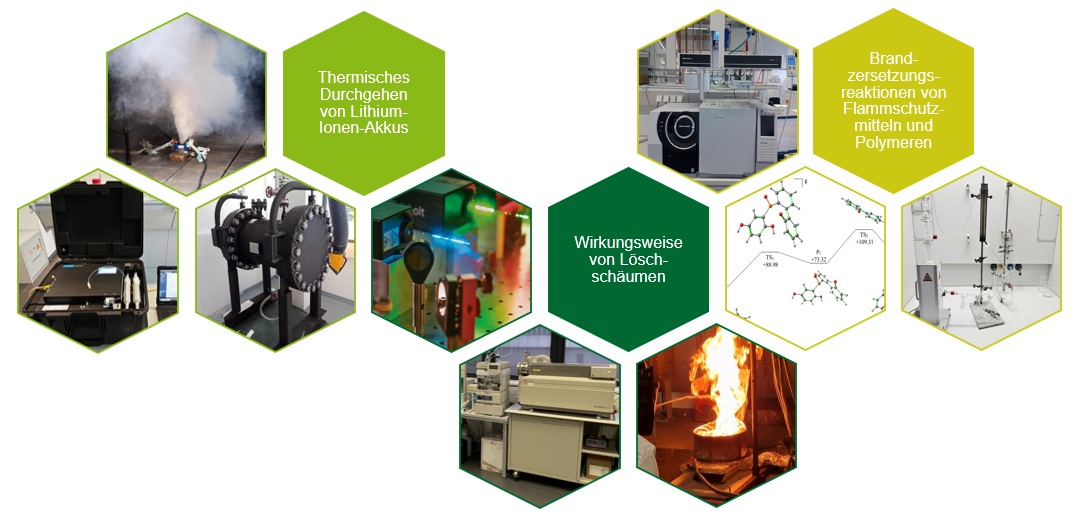
Illustration: Julia Backhaus