Protection of Insured Persons in the Suppression of Incipient Fires (SUVE)
As part of the research project ‘Protection of Insured Persons in the Suppression of Incipient Fires (SUVE)’, measures relating to the suppression of incipient fires were examined in detail with a view to improving the protection of insured persons. To this end, a wide variety of fire and extinguishing tests, as well as extensive fire simulations, were carried out in order to conduct a comprehensive assessment of early-stage firefighting in accordance with ASR A2.2. Among other things, this demonstrated that whilst the 8A test fire specified in DIN EN 3-7 is suitable for characterising the extinguishing performance of portable fire extinguishers, using this test fire to describe an incipient fire in a working environment comparable to an office setting is, however, not appropriate. Thus, when this test fire is carried out experimentally in an office-like environment, fire-induced temperatures occur which make it impossible to fight the fire safely, either with fire extinguishers classified for this purpose or with fire extinguishing sprays.
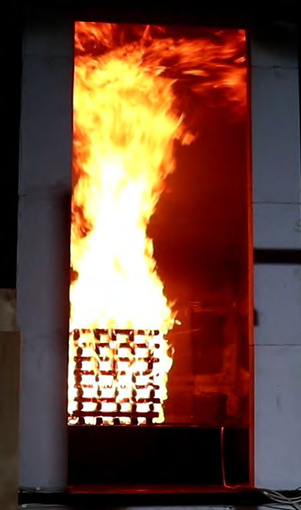
To characterise a fire in its early stages in an environment comparable to an office setting, further tests were carried out using wooden cradles modelled on the wooden cradle described in UL 1715. These tests showed that even with these significantly smaller wooden cradles, it is not possible to extinguish an incipient fire safely, as the carbon monoxide concentrations recorded during the extinguishing tests do not permit such an assessment. Rather, even in the case of these wooden nativity scene fires, firefighting can only be considered to pose a low risk.
An examination of the fundamental suitability of fire extinguishing sprays for fighting incipient fires showed that these are whilst the tests carried out did not demonstrate their suitability for incipient fires associated with a wooden nativity scene fire in accordance with UL 1715. With regard to equipping workplaces with fire-extinguishing equipment – and the associated ASR A2.2 – this means that the provision of fire extinguishing sprays is recommended, owing to the time savings in response time, and should be combined with the provision of fire extinguishers with a higher extinguishing capacity. In this way, fire extinguishers with a higher extinguishing capacity can also be used to tackle incipient fires that have progressed to a stage where fire extinguishing sprays are no longer suitable for use. It should be noted, however, that in premises comparable to those used as offices, it is no longer possible to approach the fire safely – even with fire extinguishers – due to the smoke. It is essential that the employer addresses the operational limitations of both fire extinguishing sprays and fire extinguishers as part of the training to be provided, in order to improve the protection of insured persons when tackling incipient fires.
Key points at a glance:
- Funding: German Social Accident Insurance (DGUV)
- Duration: 2 years and 8 months (project end: March 2022)
- Final report
- Publication
- In-house project manager:
- Fabian Ladzinski, MSc
- Andrea Bosnjak, MSc
- Julia Backhaus, MSc