Rescuing people from electric vehicles
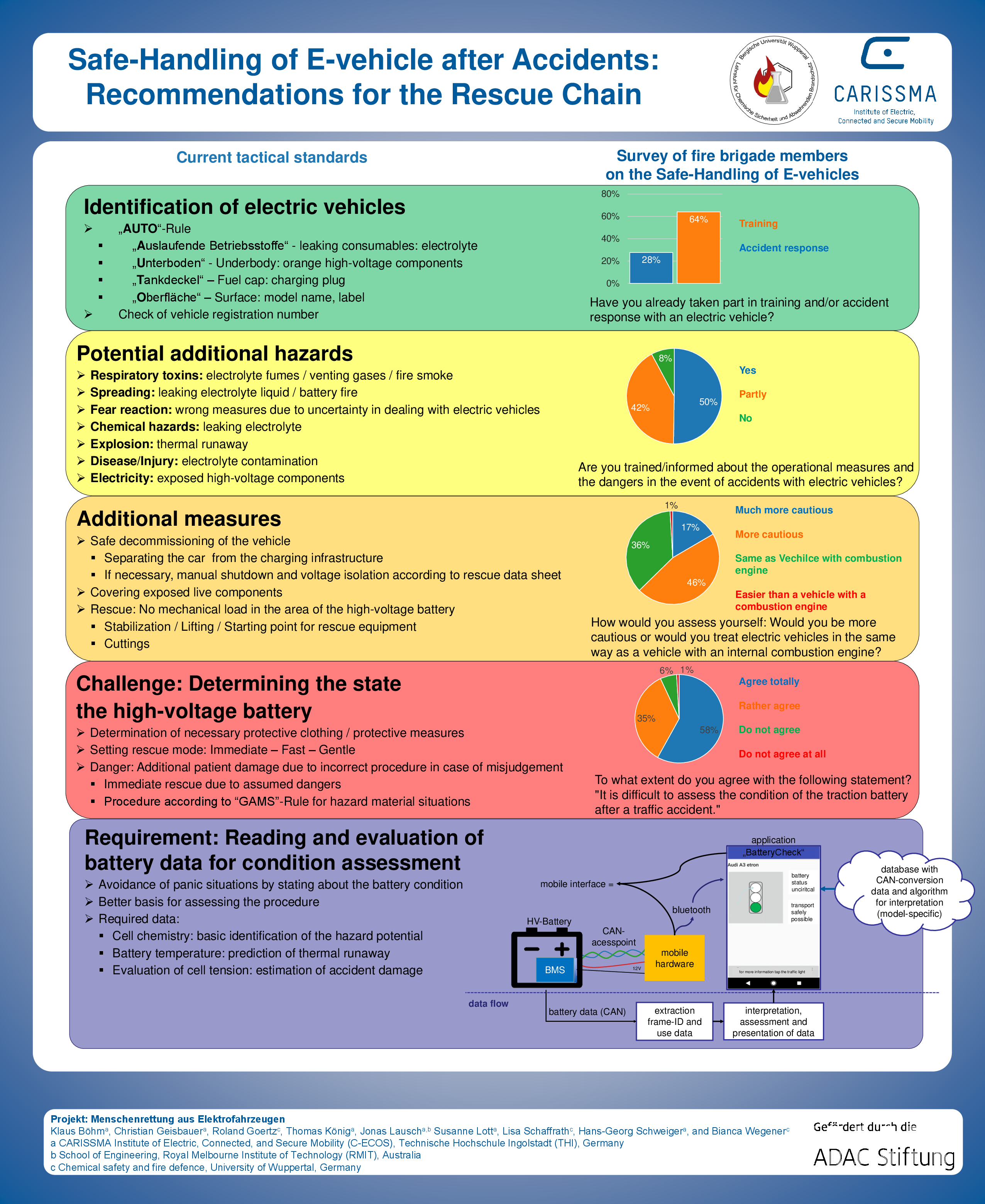
With the significant increase in the number of electric vehicles on German roads [1], the number of accidents involving battery systems is also rising. Fire services are therefore increasingly confronted with electric vehicles involved in accidents and appear noticeably uncertain, particularly when dealing with the battery modules. There is a lack of valid and standardised operational procedures for a safe approach – for both occupants and emergency services personnel – in the event of accidents involving electric vehicles. Factors at play here include, on the one hand, the possibility of thermal runaway in lithium-ion cells following a mechanical impact and, on the other hand, the health hazards posed by escaping venting gases, which are flammable and (may) contain, amongst other things, toxic and corrosive fluorine compounds [2].
Based on the current state of science and technology, as well as the findings to date of the German Association of the Automotive Industry (VDA), the Association for the Promotion of German Fire Protection (vfdb) and the emergency response data sheets, as well as manufacturers’ guidelines, a collaborative project funded by the ADAC Foundation between the University of Wuppertal (ABS Chair) and Ingolstadt University of Technology (CARISSMA) aims to develop practical operational guidelines for the fire service for the first time. These are to be based on a systematic analysis of various accident and fire scenarios and offer specific operational options for different situations. Until now, the fire service has lacked such specific guidelines for rescuing people in accidents and incidents involving electric vehicles.
The aim of the research project was to improve the safety of occupants and, in particular, of emergency services personnel when dealing with electric vehicles involved in accidents by drawing up standardised and comprehensive recommendations for action.
The background to the project was the existing uncertainty regarding the handling of electric vehicles, particularly in the event of incidents. To this end, the problems and issues faced by rescue services were first identified. Based on these findings, a need for training was identified, particularly for volunteer fire brigades, and it was determined that the rescue chain should have access to battery data.
Recommendations for action were drawn up based on the analysis of possible accident scenarios and their associated hazards. These were discussed in a subsequent workshop with numerous experts and reviewed through tabletop exercises.
To complement the predominantly conceptual work, further insights were gained through fire tests concerning the composition of the venting gases. Contrary to the data previously reported in the literature, only very small quantities of gaseous hydrogen fluoride were detected in the venting gas. Instead, in the test setup used, the compound reacted with the moisture in the air on the surfaces and remained as a solid in the combustion residue of the accumulator cell. Furthermore, it was found that even hours after thermal runaway, gases (e.g. methane) continue to be emitted from the cell, indicating that the anode material is still reacting.
Sources:
[1] Federal Motor Transport Authority, “Number of electric cars in Germany from 2012 to 2022”, available at: de.statista.com/statistik/daten/studie/265995/umfrage/anzahl-der-elektroautos-in-deutschland/, 2022.
[2] J. Garche, K. Brandt, Li-battery safety, Elsevier, San Diego, 2019.
Key points at a glance:
- Funding: ADAC Foundation
- Duration: 2 years (ending: August 2022)
- Information from the ADAC Foundation
- In-house project coordinator:
- Lisa Schaffrath, MSc
- Dr Bianca Wegener